 VAT Calculator
How To Calculate VAT
Since VAT (Value Added Tax) is expressed as a percentage, any calculation involving VAT requires working with percentages.
So to start, let's quickly recap how percentages work.
Now, when it comes to percentages, it is helpful to break the word "percent" up into its two parts – “per” and “cent”. Next think of “cent” as being short for “century” (as in a hundred years, or when a batsman gets a hundred runs in cricket) and then the word percent becomes quite intuitive and a lot easier to work with.
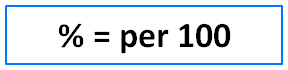
In the UK, the current standard VAT rate is 20%, which as we just saw means “20 per 100”. In short that means you pay £20 of VAT per £100 of cost.
In Mathematics per means to divide.
So we can also write 20% (which is 20 per 100) as 20 divided by 100 – that's the same as (20/100 or 0.20).
Right, so now that we understand what 20% means, we can move on to figuring out how much VAT to add onto a price to find the VAT inclusive amount, and how much VAT to subtract from a price to find the price excluding VAT.
Calculating the VAT Amount
To calculate the amount of VAT payable, it helps to remember that VAT is charged as a percentage “of “ the price.
In Mathematics, the word of means multiply.
So to calculate the VAT on any purchase price, we need to multiply the price by the VAT percentage.
For a purchase price of x, we multiply x by 20%.
But recall that 20% means 20 per 100 or 20/100.
So the VAT amount on x is simply x multiplied by 20/100 = (x)(20/100).
This is best illustrated by way of an example - for something that costs £50, we can find the VAT payable by multiplying £50 by 20%. And since 20% is just (20/100) we can calculate the amount of VAT as:

This means that there is VAT payable of £10 on a purchase price of £50.
Calculating A Price Including VAT
If a price excludes VAT and you want to know what the total cost including VAT would be, you need to calculate the VAT amount and then add it to the original amount.
Total (including VAT) = Original Amount + VAT Amount
You saw how you can get the VAT amount in the previous section (by simply multiplying the original amount by 20% (20/100)).
As an example, for something that costs £50 excluding VAT, the amount of VAT payable is £10.
The total amount including VAT would then be:
| Total (Including VAT) | = Original Amount + VAT Amount |
| = £50 + £10 | |
| = £60 |
Top Tip:
To jump straight from an amount excluding VAT to an amount including VAT of 20%, multiply the original amount by 1.20.
Total (Including VAT) = Original Amount x 1.20
Why 1.20?
Well VAT is 20% (20/100 = 0.20) and so to get to the total including VAT you need to add 0.20 to the original price (1.00) which gives 1.20
Of course if you are using the reduced VAT rate of 5%, then multiply by 1.05 (which is 1.00 + 5%) and not 1.20.
Calculate A Price Excluding VAT
If a price includes VAT and you want to know what the price would be excluding VAT, you need to calculate the VAT amount that was added in order to get to the amount including VAT.
This calculation is a little more tricky than the calculation for including VAT.
To start, we know that the price including VAT has had VAT of 20% added to the original amount. Recall that 20% is (20/100 = 0.20) and we saw in the previous section that moving from an amount which excludes VAT to an amount that includes VAT we multiplied the amount which excludes VAT by 1.20.
That means if we want to go in the opposite direction (i.e. from an amount that includes VAT to an amount which excludes VAT) we need to divide by 1.20.
Total (excluding VAT) = Total (Including VAT)/1.20
For example, if we had a total of £60 which included VAT and we wanted to find out what the value without VAT would be:
| Total (Excluding VAT) | = Total (Including VAT) / 1.20 |
| = £60 / 1.20 | |
| = £50 |
The amount of VAT which was included in the price is then simply the Total including VAT less the Total excluding VAT.
VAT Amount = Total (Including VAT) – Total (excluding VAT)
From the example above
| Total (Excluding VAT) | = Total (Including VAT) - Total (Excluding VAT) |
| = £60 - £50 | |
| = £10 |
Of course, if you don't want to do VAT calculations manually, just use our Online UK VAT Calculator which will quickly do all the number crunching for you.